
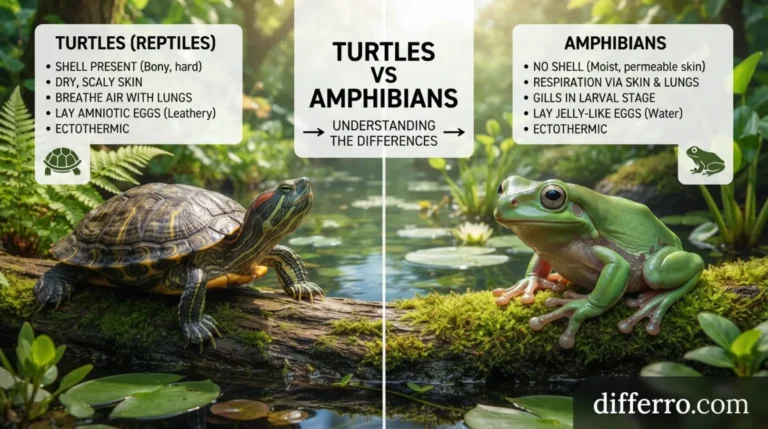
Turtles vs Amphibians: Understanding the Differences helps explain two animal groups that people often confuse. Both animals can live in or around water. However, turtles and amphibians have very different biological features.
Turtles belong to the reptile group, while amphibians form a separate animal class. Their skin, body coverings, reproduction, and life cycles also differ. Turtles have hard shells that protect their bodies. Amphibians usually have soft, moist skin that helps them absorb water and exchange gases. Frogs, toads, and salamanders belong to the amphibian group.
Turtles include sea turtles, box turtles, and freshwater turtles. Understanding these differences makes animal classification easier. This guide explains their meanings, characteristics, habitats, and examples. You will also learn how to identify turtles and amphibians in everyday life.
⭐ Quick Answer
Turtles are reptiles, while amphibians are animals such as frogs, toads, and salamanders. Turtles have protective shells, dry scaly skin, and breathe through lungs. Amphibians usually have moist skin and often undergo a life cycle involving water and land.
Example: A sea turtle is a reptile, while a frog is an amphibian.
🐢 Meaning of Turtles
Turtles are reptiles belonging to the order Testudines. They have protective shells that cover most of their bodies. Their shells contain a top section called the carapace and a bottom section called the plastron.
Turtles breathe through lungs throughout their lives. They also have dry, scaly skin and lay eggs. Most turtles live in freshwater, oceans, or on land.
However, not every turtle lives in water. Some species spend most of their lives on land.
Examples of Turtles
Example 1: Sea Turtle
Sea turtles live in oceans and have flippers that help them swim. They come onto beaches to lay their eggs.
Example 2: Box Turtle
Box turtles usually live on land. Their hinged shells help them protect their bodies from danger.
Main Characteristics of Turtles
- They belong to the reptile class.
- They have protective shells.
- Their skin has scales.
- They breathe through lungs.
- They reproduce by laying eggs.
- They have internal fertilization.
- They can live in freshwater, oceans, or on land.
- They do not undergo a typical amphibian metamorphosis.
🐸 Meaning of Amphibians
Amphibians are cold-blooded vertebrate animals belonging to the class Amphibia. They usually have soft, moist skin without scales. Many amphibians depend on water or damp environments to survive.
Most amphibians begin life as aquatic larvae. They later undergo metamorphosis and develop into adults. For example, a tadpole develops into a frog.
Amphibians can breathe through their skin and lungs. Some species also use gills during their early life stages or throughout adulthood.
Examples of Amphibians
Example 1: Frog
Frogs usually lay eggs in water. Their tadpoles develop in water before changing into adult frogs.
Example 2: Salamander
Salamanders have long bodies and tails. Many species live in damp forests, streams, or other moist environments.
Main Characteristics of Amphibians
- They belong to the class Amphibia.
- They usually have moist, glandular skin.
- They are cold-blooded animals.
- Many species undergo metamorphosis.
- They often lay eggs in water or moist environments.
- Many breathe through their skin and lungs.
- Some larvae breathe through gills.
- They commonly live in moist habitats.
🔍 Turtles vs Amphibians: Key Differences
Turtles and amphibians share some environmental features, but their biological structures differ.
| Feature | Turtles | Amphibians |
|---|---|---|
| Animal group | Reptiles | Amphibians |
| Scientific classification | Order Testudines, class Reptilia | Class Amphibia |
| Skin | Dry, scaly skin | Usually moist, smooth or textured skin |
| Body covering | Protective shell | No protective shell |
| Breathing | Lungs throughout life | Skin, lungs, or gills depending on species and life stage |
| Reproduction | Internal fertilization | Usually internal or external fertilization, depending on species |
| Eggs | Usually leathery-shelled eggs | Usually jelly-like eggs |
| Life cycle | No typical metamorphosis | Many undergo metamorphosis |
| Habitat | Land, freshwater, or oceans | Mostly moist environments, freshwater, or land |
| Examples | Sea turtles, box turtles, tortoises | Frogs, toads, salamanders, caecilians |
Key point: Turtles are reptiles, not amphibians. Their shells and dry, scaly skin help distinguish them from amphibians.
🕰️ Origin and History of Turtles and Amphibians
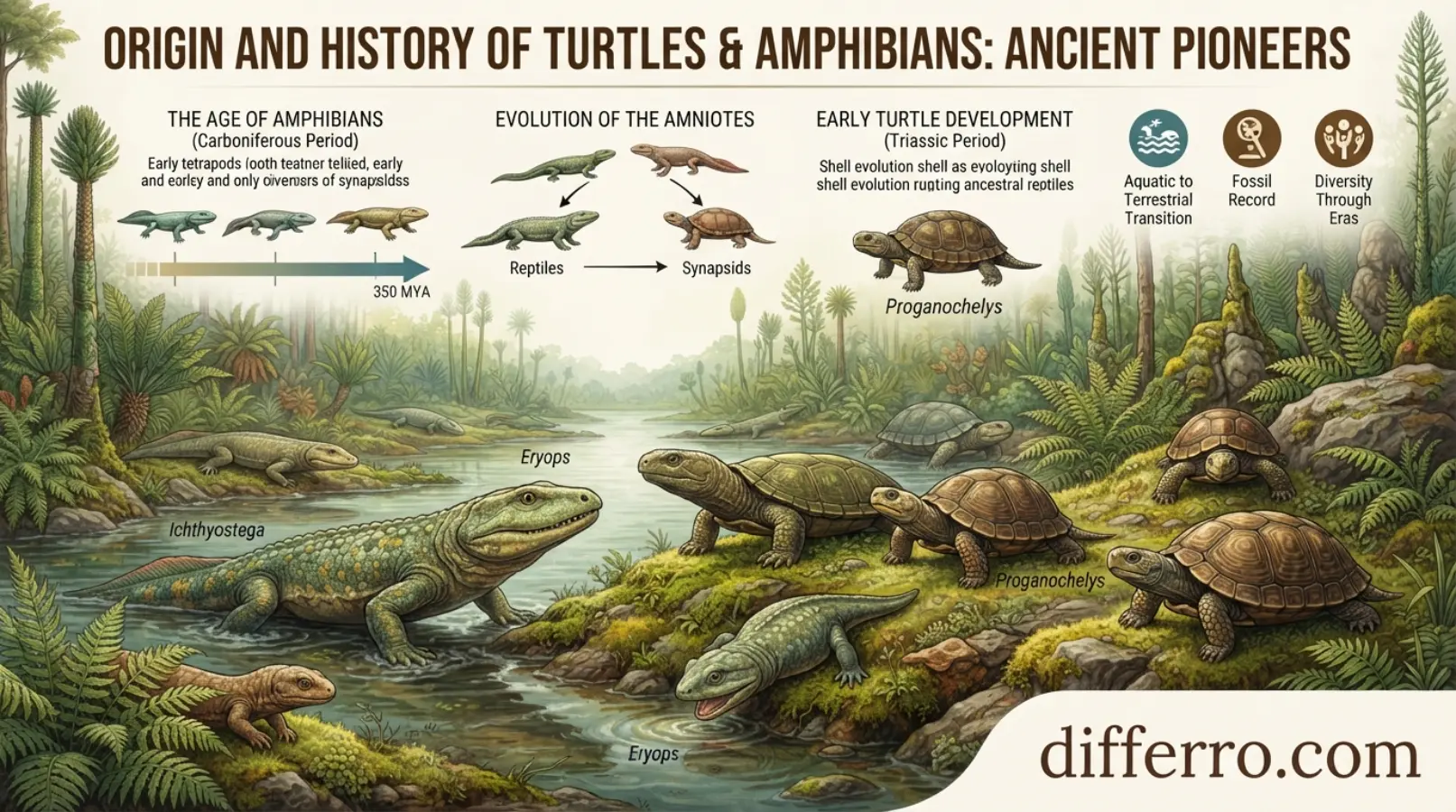
Turtles and amphibians have ancient evolutionary histories. Both groups belong to the vertebrate family tree, but they developed different adaptations.
Origin of Turtles
Turtles evolved from ancient reptile ancestors. Their fossil history dates back more than 200 million years. Early turtles developed distinctive shell structures that helped protect their bodies.
Modern turtles include many species adapted to different environments. Some live in oceans, while others inhabit rivers, lakes, and dry land.
Origin of Amphibians
Amphibians evolved from ancient vertebrate ancestors associated with early land colonization. Their distant ancestors developed features that helped vertebrates move from water into terrestrial environments.
Modern amphibians include frogs, toads, salamanders, and caecilians. Their skin and reproduction often keep them connected to moist environments.
Similar Animal Classification Examples
- Reptiles: Turtles, snakes, lizards, and crocodiles.
- Amphibians: Frogs, toads, salamanders, and caecilians.
- Mammals: Humans, elephants, dogs, and whales.
- Birds: Eagles, parrots, penguins, and sparrows.
- Fish: Salmon, tuna, goldfish, and sharks.
These groups have different body structures, reproductive methods, and evolutionary adaptations.
🇬🇧 British English vs American English Spelling
The words turtle and amphibian have the same spelling in British and American English.
Both countries use these terms in science, education, and everyday conversations.
The main differences involve regional animal names and terminology, not the spelling of these words.
British vs American English Comparison
| Feature | British English | American English |
|---|---|---|
| Turtle | Turtle | Turtle |
| Amphibian | Amphibian | Amphibian |
| Tortoise | Tortoise | Tortoise |
| Frog | Frog | Frog |
| Scientific meaning | Same | Same |
| General usage | Education and science | Education and science |
🐢 When to Use the Term Turtles
Use the term turtles when discussing animals from the reptile order Testudines.
Turtles have protective shells and breathe through lungs. They include marine, freshwater, and land-dwelling species.
1. When Discussing Reptiles
Turtles belong to the reptile group, alongside snakes, lizards, and crocodiles.
Example: Turtles are reptiles because they share important characteristics with other reptiles.
2. When Discussing Protective Shells
Use turtles when describing animals with protective shells.
Example: Turtles use their shells to protect their bodies from predators and environmental dangers.
3. When Discussing Aquatic Animals
Many turtles live in rivers, lakes, and oceans.
Example: Sea turtles travel through oceans and return to beaches to lay eggs.
4. When Discussing Land Animals
Some turtles live mainly on land. Tortoises are a well-known example.
Example: A tortoise uses its strong legs to walk across dry land.
🐸 When to Use the Term Amphibians
Use the term amphibians when discussing animals belonging to the class Amphibia.
These animals usually have moist skin and often depend on water during reproduction or early development.
1. When Discussing Frogs and Toads
Frogs and toads belong to the amphibian group.
Example: Frogs are amphibians because they share the biological characteristics of this animal class.
2. When Discussing Metamorphosis
Many amphibians change their body structure as they develop.
Example: A tadpole undergoes metamorphosis as it develops into an adult frog.
3. When Discussing Moist Skin
Amphibians often have moist skin that helps with gas exchange.
Example: A salamander needs a suitable moist environment to keep its skin functioning properly.
4. When Discussing Aquatic and Terrestrial Life
Many amphibians use both aquatic and terrestrial habitats during their lives.
Example: A frog may begin life in water and later spend time on land.
⚠️ Common Mistakes When Comparing Turtles and Amphibians
Mistake 1: Calling Turtles Amphibians
Incorrect: Turtles are amphibians because they live in water.
Correct: Turtles are reptiles. Some species live in water, but their classification does not change.
Mistake 2: Assuming All Amphibians Live in Water
Incorrect: Every amphibian spends its entire life underwater.
Correct: Many adult amphibians live on land, although they often need moist environments.
Mistake 3: Thinking Every Turtle Lives in the Ocean
Incorrect: All turtles are marine animals.
Correct: Turtles include ocean-dwelling, freshwater, and land-dwelling species.
Mistake 4: Assuming Amphibians Have Shells
Incorrect: Frogs and salamanders have protective shells like turtles.
Correct: Amphibians generally lack external protective shells. Their skin is an important part of their biology.
Mistake 5: Thinking All Amphibians Lay Eggs in Water
Incorrect: Every amphibian lays eggs directly in ponds or lakes.
Correct: Many amphibians lay eggs in water, but some use moist land environments or have different reproductive strategies.
Mistake 6: Assuming Turtles and Amphibians Breathe the Same Way
Incorrect: Turtles and all amphibians use gills throughout their lives.
Correct: Turtles breathe through lungs. Amphibians use different breathing methods depending on their species and life stage.
🧠 Easy Trick to Remember
Use this simple memory trick:
- Turtles = Shells and Scales: Remember their protective shells and reptile classification.
- Amphibians = Moist Skin and Metamorphosis: Remember frogs, toads, and salamanders.
A turtle is a reptile, even when it swims in water. A frog is an amphibian, even when it spends time on land.
This simple trick makes animal classification easier to remember.
🌿 Everyday-Life Examples: Turtles vs Amphibians
1. Seeing a Turtle in a Pond
You visit a local pond and notice an animal swimming with a hard shell.
Correct classification: It is likely a freshwater turtle. Turtles remain reptiles even when they spend much of their time underwater.
Primary keyword: Turtles vs Amphibians.
2. Watching a Frog Near a Lake
You notice a frog sitting on a wet rock beside a lake.
Correct classification: A frog is an amphibian because it belongs to the class Amphibia.
Secondary keyword: Difference between turtles and amphibians.
3. Observing a Tadpole in Water
You find small tadpoles swimming in a pond. They have tails and look different from adult frogs.
Correct classification: Tadpoles are the larval stage of frogs and other anurans. They belong to the amphibian group.
Secondary keyword: Turtle and amphibian life cycle.
4. Finding a Tortoise in a Garden
You see a slow-moving animal with a strong shell walking through a garden.
Correct classification: It is a tortoise, which belongs to the turtle order Testudines and the reptile group.
Secondary keyword: Turtles vs amphibians examples.
5. Seeing a Salamander Under a Wet Log
You lift a fallen log and notice a small animal with moist skin and a long tail.
Correct classification: It may be a salamander, which belongs to the amphibian group.
Secondary keyword: Examples of amphibians and reptiles.
🌍 Google Trends and Usage Insights: Five Countries
Google Trends measures relative search interest rather than exact search volume. The following observations are general topic insights, not verified live rankings.
- USA: Searches may focus on turtle identification, amphibian classification, and educational comparisons.
- UK: Students may search for differences between reptiles and amphibians for biology lessons.
- Australia: Wildlife education may encourage searches about turtles, frogs, and native amphibians.
- India: Students may look for turtle characteristics, amphibian examples, and animal classification.
- Pakistan: Educational searches may focus on reptile and amphibian differences, particularly for school science.
SEO insight: Compare the exact keyword with related searches in Google Trends using the same date range. Check each country separately because search interest varies by region. Educational and biology-related variations can help expand the article’s search reach.
Comparison Table: Keyword Variations
| Keyword variation | Search intent | Suggested content use |
|---|---|---|
| Turtles vs Amphibians | Direct comparison | Main title and introduction |
| Difference between turtles and amphibians | Informational | Key differences section |
| Are turtles amphibians or reptiles? | Classification question | Quick Answer and FAQ |
| Turtle characteristics | Educational | Meaning of turtles |
| Amphibian characteristics | Educational | Meaning of amphibians |
| Reptiles vs amphibians | Broader comparison | Origin and history |
| Examples of reptiles and amphibians | Learning and examples | Everyday-life examples |
❓ Frequently Asked Questions
1. Is it correct to compare turtles and amphibians?
Yes. Turtles and amphibians are different animal groups, so comparing their characteristics is scientifically useful. Turtles belong to the reptile group, while frogs and salamanders belong to Amphibia.
2. What is the main difference between turtles and amphibians?
Turtles have protective shells, dry scaly skin, and lungs. Amphibians usually have moist skin and may breathe through their skin, lungs, or gills.
3. Which group is more common, turtles or amphibians?
Amphibians include more known species than turtles. Scientists recognize thousands of amphibian species, while turtles have several hundred recognized species. Exact counts change as scientists describe and reclassify species.
4. What is the formal scientific difference between turtles and amphibians?
Turtles belong to the order Testudines within class Reptilia. Amphibians belong to class Amphibia. These classifications reflect major differences in their evolutionary history and biological characteristics.
5. Why do people confuse turtles with amphibians?
People often confuse these animals because many turtles and amphibians live near water. However, habitat alone does not determine animal classification. Their skin, body structure, reproduction, and evolutionary relationships distinguish them.
🏆 Final Verdict: Turtles or Amphibians?
Turtles and amphibians are different animal groups with unique biological characteristics. Turtles belong to the reptile group and have protective shells, scaly skin, and lungs. Amphibians include frogs, toads, salamanders, and caecilians.
Neither group is better than the other. Each has special adaptations that help it survive in different environments.
Choose the term turtles when discussing shelled reptiles. Use amphibians when discussing animals with amphibian characteristics, such as frogs and salamanders.
The most important distinction is their scientific classification. Turtles are reptiles, not amphibians, even when they spend much of their lives in water.
Conclusion
Turtles vs Amphibians: Understanding the Differences helps explain two distinct groups of Vertebrate animals. Turtles belong to the reptile group and have protective shells, scaly skin, and lungs. Amphibians include frogs, toads, salamanders, and caecilians. They usually have moist skin and often undergo metamorphosis during development.
Although both groups may live near water, their biological features make them different. Turtles remain reptiles regardless of their habitat. Amphibians have special adaptations that connect many species to both aquatic and terrestrial environments.
Remember the simple distinction: turtles have shells, while amphibians generally have moist skin. Understanding these features makes animal identification and scientific classification easier.

Imran Lodhra is a comparison-focused content writer at Differro.com.
He specializes in creating clear, simple, and informative comparison articles.
His work helps readers understand key differences, pros and cons, and important details.
Imran focuses on accurate, practical, and easy-to-read content for everyday readers.