
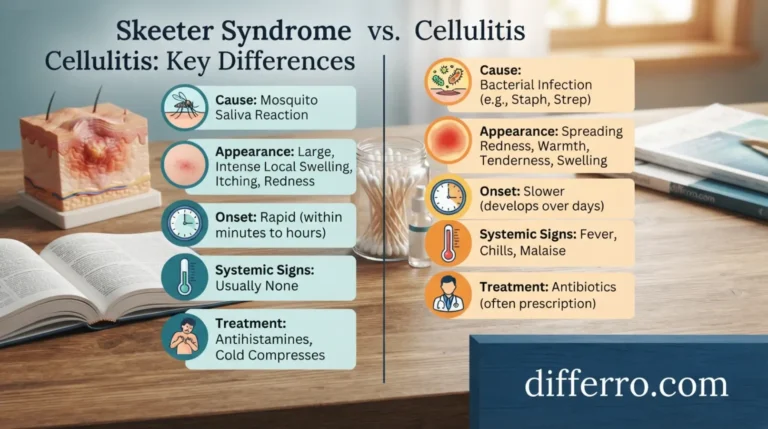
Skeeter syndrome or cellulitis can cause redness, swelling, warmth, and discomfort after a mosquito bite. However, these conditions have different causes and treatments. Skeeter syndrome is an allergic reaction to proteins in mosquito saliva. Cellulitis is a bacterial infection that affects deeper skin tissues.
Both conditions can make a mosquito bite look red, swollen, and inflamed. This similarity often makes it difficult to identify the problem. However, the timing, itching, pain, and spread of redness can provide useful clues. Skeeter syndrome often causes rapid swelling and intense itching within hours. Cellulitis may cause increasing tenderness, warmth, and spreading redness.
Understanding these differences can help you recognize warning signs and seek appropriate care. However, symptoms alone cannot confirm either condition. A healthcare professional can examine the affected area and recommend the right treatment.
⭐ Quick Answer
Skeeter syndrome is an allergic reaction to mosquito saliva, while cellulitis is a bacterial skin infection. Skeeter syndrome often causes rapid swelling and intense itching. Cellulitis may cause spreading redness, increasing pain, warmth, and fever.
Example: A very itchy, swollen bite appearing within hours may suggest skeeter syndrome. Redness that continues spreading with increasing pain may indicate cellulitis.
🔎 Meaning of Skeeter Syndrome
Skeeter syndrome is a strong local allergic reaction to proteins in mosquito saliva. It causes more swelling, redness, and itching than an ordinary mosquito bite.
Symptoms often begin within hours of a bite. Swelling can become quite large, especially around the eyes, hands, feet, or other sensitive areas.
Common symptoms include:
- Significant swelling around the bite
- Intense itching
- Redness and warmth
- Skin tenderness or discomfort
- Occasionally, blisters or a low-grade fever
Most reactions gradually improve over several days, although some last longer.
Examples of Skeeter Syndrome
Example 1: A child develops a large, itchy, swollen patch on the arm a few hours after a mosquito bite.
Example 2: An adult wakes up with a swollen ankle and intense itching after spending an evening outdoors.
These examples may suggest skeeter syndrome, but a clinician should assess severe or worsening symptoms.
🦠 Meaning of Cellulitis
Cellulitis is a bacterial infection that affects deeper skin layers and the tissue underneath. Bacteria can enter through cuts, scratches, insect bites, or damaged skin.
A mosquito bite can become infected when scratching breaks the skin. However, not every swollen or red bite develops cellulitis.
Common symptoms include:
- Redness that spreads beyond the original bite
- Increasing pain or tenderness
- Warm, swollen skin
- Fever or chills in some cases
- Swollen nearby lymph nodes
- Feeling generally unwell
Cellulitis requires prompt medical assessment and usually needs antibiotics. Without appropriate treatment, the infection can spread and cause serious complications.
Examples of Cellulitis
Example 1: Someone scratches a mosquito bite until the skin breaks. The next day, the redness spreads and the area becomes increasingly painful.
Example 2: A person develops a warm, tender patch around an insect bite and later experiences fever and chills.
These symptoms raise concern for cellulitis and require prompt medical evaluation.
📊 Skeeter Syndrome or Cellulitis: Key Differences
The main difference between skeeter syndrome and cellulitis is the underlying cause. One involves an allergic reaction, while the other involves a bacterial infection.
| Feature | Skeeter Syndrome | Cellulitis |
|---|---|---|
| Meaning | Strong local allergic reaction | Bacterial infection of deeper skin tissues |
| Cause | Proteins in mosquito saliva | Bacteria entering damaged skin |
| Typical onset | Often within hours | May develop over a day or more, but timing varies |
| Main symptom | Intense itching | Increasing pain and tenderness |
| Swelling | Can become large quickly | Often accompanies redness and tenderness |
| Redness | Often remains around the bite | May spread beyond the original area |
| Skin warmth | Common | Common |
| Fever | Sometimes occurs | May occur, especially with more serious infection |
| Treatment | Symptom relief and allergy management | Medical assessment and usually antibiotics |
| Typical course | Often improves over several days | May worsen without treatment |
Important: These patterns are helpful clues, not diagnostic rules. Skeeter syndrome can cause significant warmth and redness. Cellulitis can occur without fever or severe pain.
🕰️ Origin and History
The term skeeter syndrome describes a pronounced allergic reaction to mosquito bites. “Skeeter” is an informal English word for mosquito.
Medical professionals use the term to describe reactions that cause unusually large swelling, redness, and itching. These symptoms result from the body’s immune response to mosquito saliva.
The word cellulitis comes from medical terminology associated with cellular tissue and inflammation. Today, doctors use it to describe a bacterial infection involving deeper skin tissues.
Although both conditions can follow a mosquito bite, they describe different medical problems.
Similar Medical Terms
- Mosquito bite reaction: A common local response that causes a small, itchy bump.
- Skeeter syndrome: A pronounced allergic reaction with substantial swelling.
- Cellulitis: A bacterial infection involving deeper skin tissues.
- Abscess: A collection of pus within tissue.
- Contact dermatitis: Skin inflammation caused by contact with an irritant or allergen.
Understanding these terms helps explain why similar-looking skin problems may require different treatments.
🇬🇧 British English vs American English Spelling
Skeeter syndrome and cellulitis have the same standard spelling in British and American English.
Related words may differ, such as localised in British English and localized in American English.
These spelling differences do not change the medical meaning of either condition.
British vs American English Comparison
| Feature | British English | American English |
|---|---|---|
| Skeeter syndrome | Skeeter syndrome | Skeeter syndrome |
| Cellulitis | Cellulitis | Cellulitis |
| Local skin reaction | Localised reaction | Localized reaction |
| Medical meaning | Same | Same |
| Usage | Medical and everyday discussions | Medical and everyday discussions |
🩺 When to Suspect Skeeter Syndrome
Skeeter syndrome may be more likely when a mosquito bite causes rapid swelling and intense itching.
Look for these common clues:
- Swelling develops within hours of the bite.
- Itching feels more noticeable than pain.
- The affected area becomes red, warm, and puffy.
- The swelling remains mainly around the bite.
- Symptoms gradually improve over several days.
Some people experience stronger mosquito bite reactions than others. Children and people with a history of pronounced reactions may develop particularly noticeable swelling.
Example of Possible Skeeter Syndrome
A child develops a large, itchy bump on the leg several hours after playing outdoors. The area becomes swollen and warm, but the child otherwise feels well.
This pattern may suggest skeeter syndrome. However, a large reaction does not automatically rule out infection.
Seek medical advice for severe swelling, significant pain, fever, or worsening symptoms.
What Helps Skeeter Syndrome?
Depending on your age and medical history, a healthcare professional or pharmacist may recommend:
- A cool compress to reduce itching and swelling
- An appropriate oral antihistamine
- A suitable topical treatment for itching
- Gentle skin care and avoiding scratching
Follow product instructions and professional advice. Avoid applying irritating products to broken skin.
🚨 When to Suspect Cellulitis
Cellulitis becomes a concern when redness, warmth, swelling, and pain continue to increase. The affected area may expand beyond the original bite.
Warning signs include:
- Redness that keeps spreading
- Increasing pain or tenderness
- Worsening swelling and warmth
- Fever or chills
- Red streaks extending away from the affected area
- Feeling unusually weak or unwell
Cellulitis can develop after scratching a mosquito bite. However, a clinician must assess the skin to determine whether a bacterial infection is present.
Example of Possible Cellulitis
An adult scratches a mosquito bite until it bleeds. The following day, the surrounding skin becomes increasingly painful, hot, and red. The redness continues to spread.
This pattern raises concern for cellulitis. Seek prompt medical care instead of relying on home remedies.
How Do Doctors Treat Cellulitis?
Doctors generally prescribe antibiotics when they diagnose bacterial cellulitis. The specific medicine depends on the suspected bacteria, infection severity, allergies, and individual circumstances.
Some people require hospital treatment when the infection becomes severe or complications develop. Never use leftover antibiotics or someone else’s prescription.
Seek emergency care for confusion, faintness, severe illness, rapidly worsening symptoms, or other signs of a serious infection.
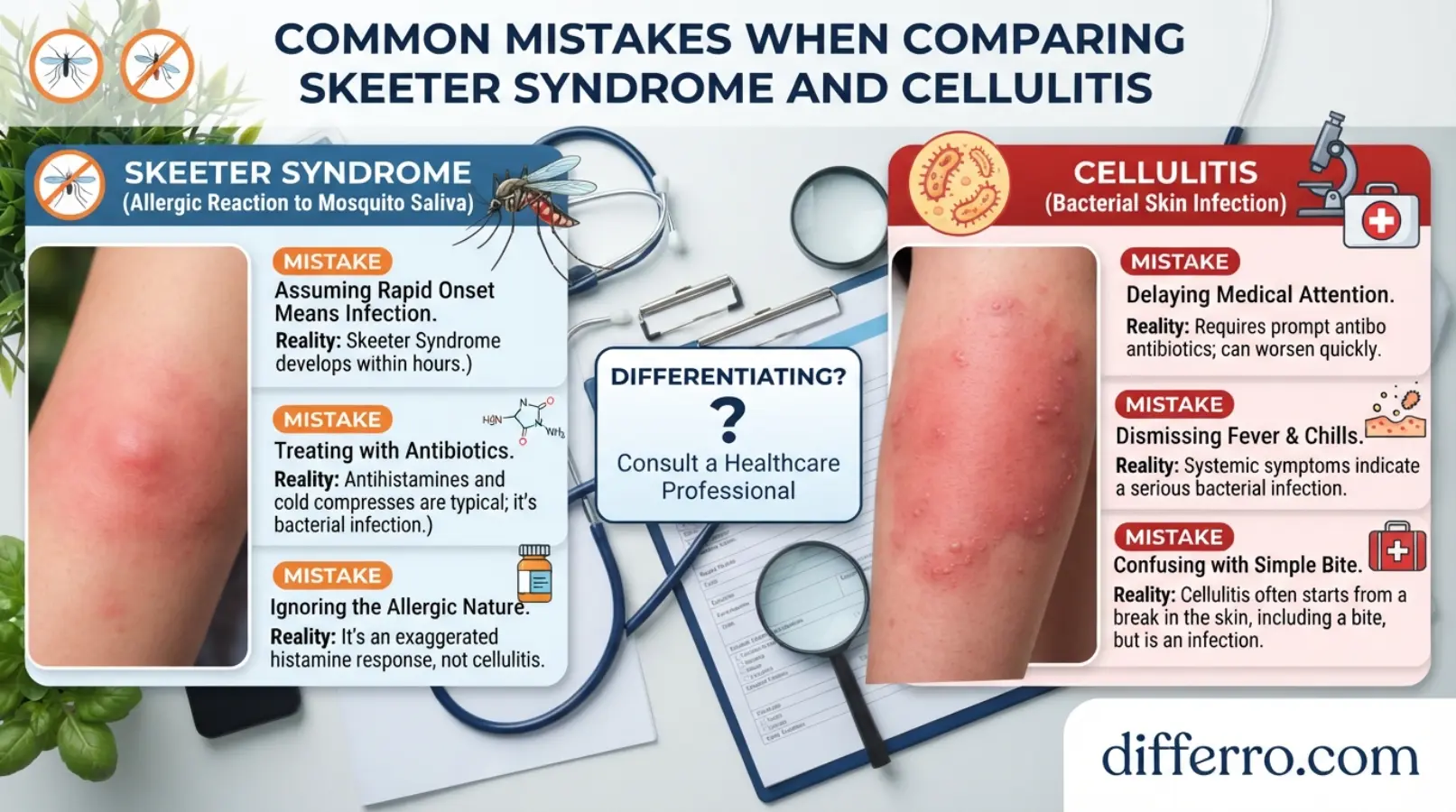
⚠️ Common Mistakes When Comparing Skeeter Syndrome and Cellulitis
Mistake 1: Assuming All Redness Means Infection
Incorrect: Every red, swollen mosquito bite needs antibiotics.
Correct: Allergic reactions can also cause redness, warmth, and swelling. A healthcare professional can assess possible infection.
Mistake 2: Assuming Itching Rules Out Cellulitis
Incorrect: If a mosquito bite itches, it cannot be cellulitis.
Correct: Itching can accompany several skin conditions. Increasing pain, spreading redness, and other warning signs still matter.
Mistake 3: Waiting for Fever Before Seeking Help
Incorrect: Cellulitis cannot occur without fever.
Correct: Cellulitis can develop without fever. Spreading redness, warmth, and increasing tenderness deserve prompt medical assessment.
Mistake 4: Assuming Every Large Reaction Is Skeeter Syndrome
Incorrect: A large swelling after a mosquito bite always means skeeter syndrome.
Correct: Allergic reactions, infections, and other skin conditions can look similar. A clinician should assess severe or worsening reactions.
Mistake 5: Using Antibiotics for an Allergic Reaction
Incorrect: Antibiotics will treat every swollen mosquito bite.
Correct: Antibiotics treat bacterial infections, not allergic reactions. Correct identification helps prevent unnecessary medication use.
Mistake 6: Ignoring Symptoms That Keep Worsening
Incorrect: Every mosquito bite reaction improves without medical care.
Correct: Some reactions require medical assessment. Seek help when redness spreads, pain increases, or you feel unwell.
🧠 Easy Trick to Remember
Use this simple memory tip:
- Skeeter syndrome = saliva sensitivity. Think of an allergic reaction, intense itching, and rapid swelling.
- Cellulitis = bacterial infection. Think of spreading redness, increasing tenderness, and possible fever.
This trick can help you remember the difference, but it cannot confirm a diagnosis.
🌿 Everyday-Life Examples: Skeeter Syndrome or Cellulitis
1. A Large, Itchy Bite on the Arm
A child develops significant swelling and intense itching a few hours after a mosquito bite. The redness stays near the bite, and the child feels well.
Possible explanation: Skeeter syndrome may fit this pattern. Monitor symptoms and seek medical advice if they worsen.
2. A Bite That Becomes More Painful
An adult scratches a bite, and the skin becomes increasingly tender the following day. Redness continues to expand.
Possible explanation: Cellulitis is a concern. The person should seek prompt medical evaluation.
3. Swelling Around an Eyelid
A mosquito bite near the eye causes substantial swelling and itching within hours.
Possible explanation: A strong allergic reaction may explain the swelling. Because the affected area surrounds the eye, seek medical advice promptly. Eye pain, vision changes, fever, or worsening redness require urgent assessment.
4. A Bite Accompanied by Fever and Chills
A person notices increasing redness around a bite and develops fever and chills.
Possible explanation: Cellulitis or another infection may be responsible. Seek urgent medical assessment.
5. A Swollen Bite That Gradually Improves
A mosquito bite becomes itchy, red, and swollen during the first day. The swelling gradually decreases over several days.
Possible explanation: This course may fit a local allergic reaction or skeeter syndrome. However, improvement alone cannot establish a diagnosis.
🌍 Google Trends and Usage Insights: Five Countries
Google Trends measures relative search interest rather than actual search volumes. Exact country rankings require a live comparison of the relevant search terms.
- USA: Search interest may include comparisons between mosquito bite reactions and skin infections.
- UK: People may search for cellulitis symptoms when investigating a suspected skin infection.
- Australia: Mosquito exposure may prompt searches about swelling, itching, and unusual bite reactions.
- India: Related searches may focus on mosquito bite swelling, redness, infection, and treatment.
- Pakistan: Users may search for swollen mosquito bites, itching, and signs of infection.
SEO insight: These are topic-based expectations, not verified Google Trends findings. Compare the exact keywords across all five countries before publishing numerical rankings. Include related search phrases because many people describe their symptoms without knowing the medical terms.
Comparison Table: Keyword Variations
| Keyword variation | Search intent | Recommended placement |
|---|---|---|
| Skeeter syndrome or cellulitis | Direct comparison | Main title and introduction |
| Skeeter syndrome vs cellulitis | Informational comparison | Key differences section |
| Skeeter syndrome symptoms | Symptom research | Skeeter syndrome section |
| Cellulitis after mosquito bite | Infection concern | Cellulitis section |
| Infected mosquito bite or allergic reaction | Symptom identification | FAQ section |
| Mosquito bite swelling and redness | General symptom research | Introduction and examples |
| How to tell if a mosquito bite is infected | Practical medical guidance | Warning signs section |
❓ Frequently Asked Questions
1. Is “skeeter syndrome or cellulitis” a correct comparison?
Yes. The phrase compares two conditions that can cause swelling after a mosquito bite. Skeeter syndrome is an allergic reaction, while cellulitis is a bacterial infection.
2. What is the main difference between skeeter syndrome and cellulitis?
Skeeter syndrome often causes rapid swelling and intense itching. Cellulitis often causes spreading redness, increasing tenderness, and warmth. However, symptoms can overlap.
3. Which condition is more common?
Ordinary mosquito bite reactions are common, while skeeter syndrome describes a pronounced allergic reaction. Cellulitis is a separate bacterial infection. Reliable comparative rates for these two specific diagnoses vary, so a universal ranking would be misleading.
4. When should I seek medical help for a swollen mosquito bite?
Seek prompt medical care if redness spreads, pain increases, swelling worsens, or you develop fever or chills. Seek emergency care for severe illness, confusion, faintness, or rapidly worsening symptoms.
5. Why do people confuse skeeter syndrome with cellulitis?
Both conditions can cause red, warm, swollen skin. Skeeter syndrome may produce dramatic swelling that resembles an infection. Cellulitis can also develop near a mosquito bite, making the conditions difficult to distinguish without medical assessment.
✅ Final Verdict: Which Condition Is It?
Skeeter syndrome and cellulitis can look similar, but their causes differ. Skeeter syndrome results from an allergic reaction to mosquito saliva. Cellulitis develops when bacteria infect deeper skin tissues.
Rapid swelling and intense itching may suggest skeeter syndrome, particularly when symptoms begin within hours. Spreading redness, increasing pain, tenderness, and fever raise greater concern for cellulitis.
Neither condition can be confirmed through appearance alone. Seek prompt medical care when symptoms worsen or infection seems possible. A clinician can determine whether you need allergy treatment, antibiotics, or another approach.
When in doubt, prioritize medical assessment instead of waiting for symptoms to become more obvious.
Conclusion
Skeeter syndrome or cellulitis is an important comparison when a mosquito bite causes unusual swelling, redness, or discomfort. Skeeter syndrome involves an allergic reaction to mosquito saliva. Cellulitis involves a bacterial infection of deeper skin tissues.
The most useful clues include symptom timing, itching, pain, and spreading redness. Skeeter syndrome often causes rapid swelling and intense itching. Cellulitis more often causes increasing tenderness and expanding redness, sometimes with fever.
However, these signs can overlap, and neither condition always follows a typical pattern. Do not rely on appearance alone to make a diagnosis. Seek prompt medical care for spreading redness, worsening pain, fever, or other concerning symptoms. Early assessment helps you receive appropriate treatment and reduces the risk of complications.

Imran Lodhra is a comparison-focused content writer at Differro.com.
He specializes in creating clear, simple, and informative comparison articles.
His work helps readers understand key differences, pros and cons, and important details.
Imran focuses on accurate, practical, and easy-to-read content for everyday readers.